
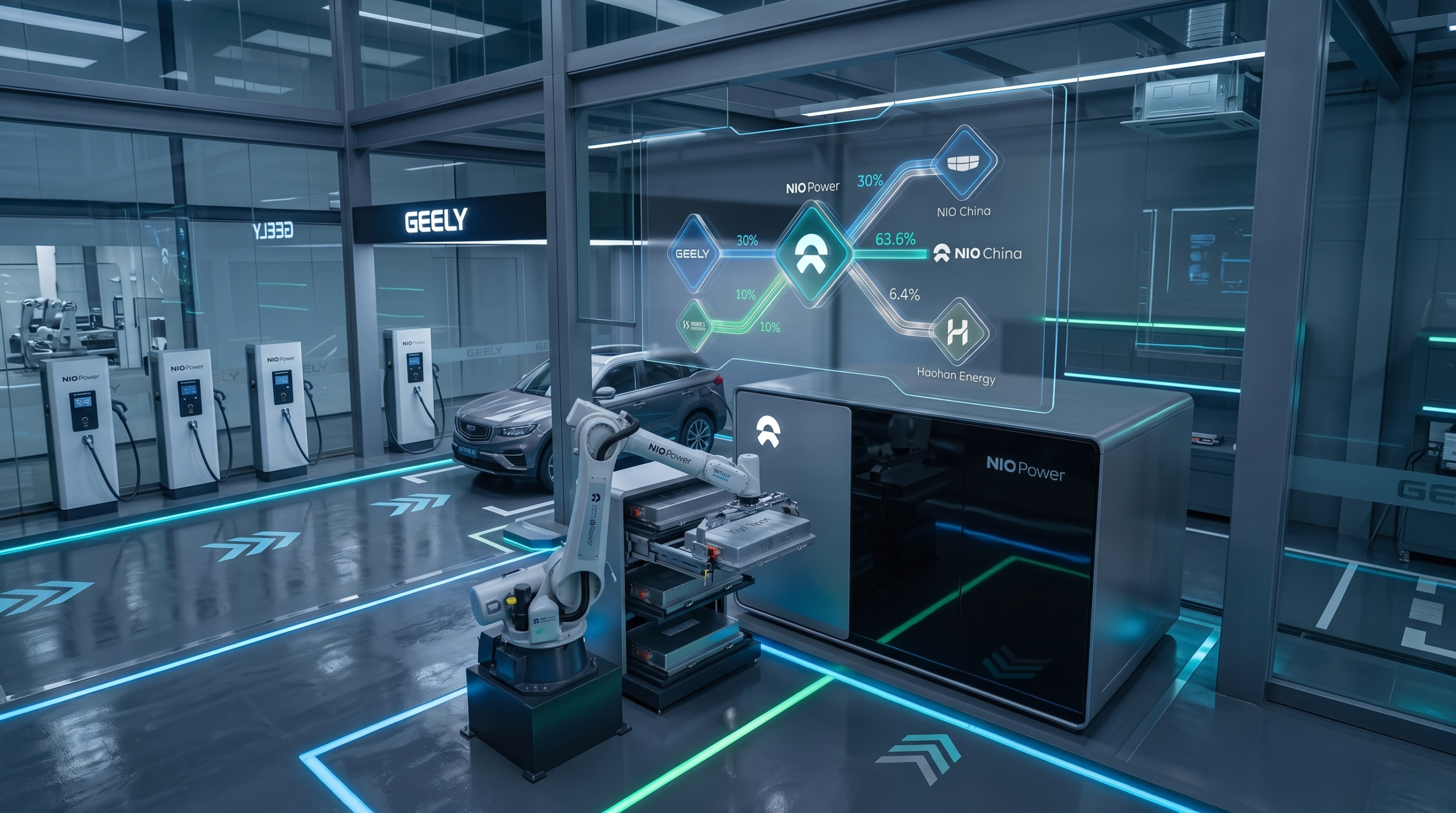
NIO Geely Partnership
NIO Geely announcement and what happens when two companies that could compete decide there is more value in connecting their systems instead?
This week, Chinese electric vehicle manufacturer NIO announced a significant expansion of its relationship with Zhejiang Geely Holding Group. On the surface, it is a deal involving battery swapping and EV charging.
Look a little deeper and it becomes a story about something much bigger: partnerships, infrastructure, standardisation, energy and the changing economics of competition.
It is also another example of Newton’s Law of Connectivity – Nothing happens in isolation.
Key Points About Nio Geely Partnership
- Geely is taking a 30% stake in NIO Power, valuing the business at approximately RMB16 billion (US$2.4 billion).
- NIO is taking a 10% stake in Geely’s Haohan Energy, creating a two-way infrastructure partnership rather than a simple investment.
- NIO has completed more than 100 million battery swaps, demonstrating that battery swapping is already operating at significant scale.
- Shared infrastructure could reduce duplicated investment while increasing utilisation as more compatible vehicles use the network.
- Battery-swap stations can connect to the electricity grid, turning EV infrastructure into potential energy-storage and grid-management assets.
- China is developing common battery-swapping standards, potentially making infrastructure accessible across multiple manufacturers.
- NIO’s sales and service network now spans 24 countries and regions, adding an international dimension to its growing ecosystem.
- The bigger investment story may be the infrastructure behind EVs, rather than simply which manufacturer sells the most cars.
- Newton’s Law of Connectivity: EVs connect to batteries, batteries to infrastructure, infrastructure to energy, and energy back to the wider economy.
Table of Contents
Observation: Geely Takes a Stake in NIO Power
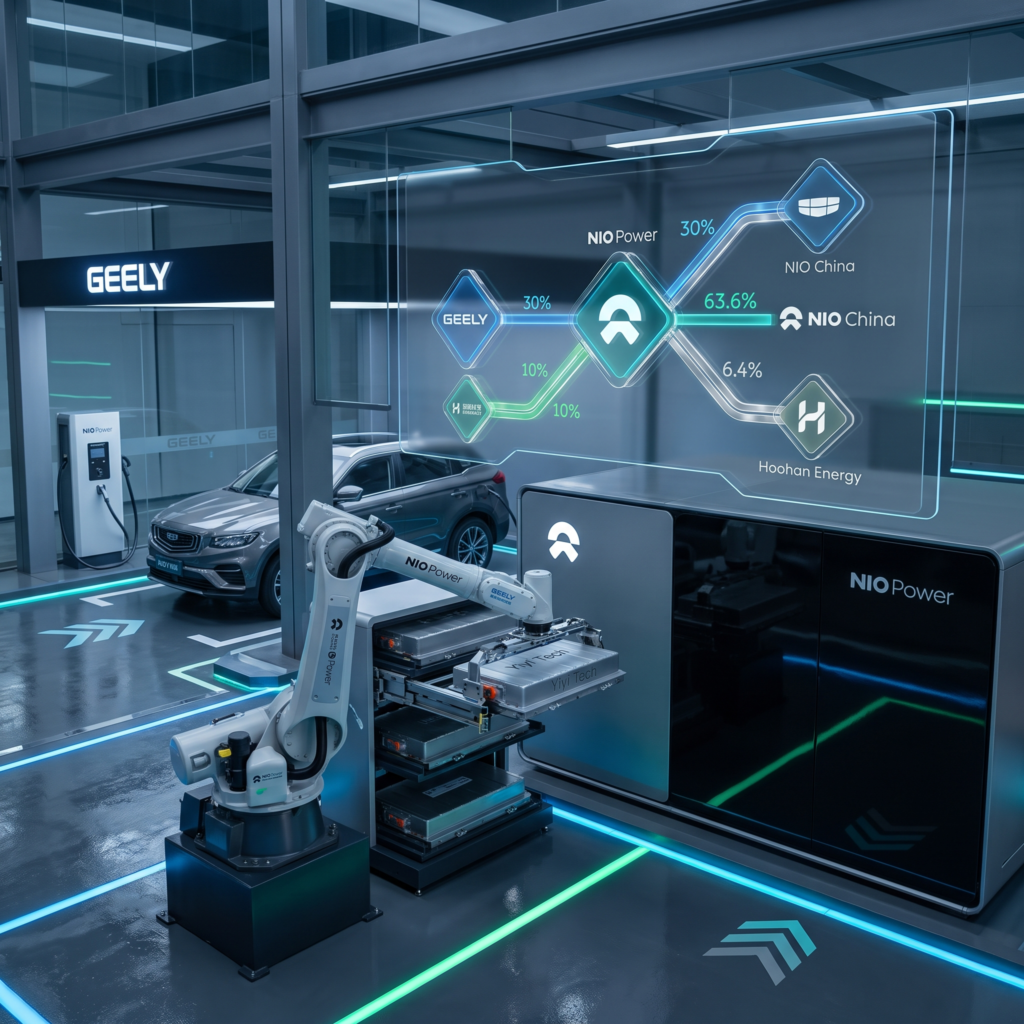
Under agreements announced on 27 September 2026, a Geely subsidiary will contribute its entire ownership of Yiyi Internet Technology its commercial battery-swapping operation together with RMB640 million in cash to NIO Power. In return, Geely will initially receive a 30% stake in NIO Power. NIO China will retain control with 63.6%, while an existing investor will hold the remaining 6.4%. The transaction values NIO Power at approximately RMB16 billion, or around US$2.4 billion.
But the relationship works in both directions. NIO China will also acquire a 10% interest in Geely’s Haohan Energy charging business.
So this isn’t simply Geely investing in NIO. The two companies are beginning to connect their respective energy infrastructures.
The deal builds on a strategic battery-swapping partnership established between NIO and Geely in 2023, when they agreed to cooperate on areas including battery standards, swapping technology, network expansion and swappable vehicle development.
Three years later, cooperation has evolved into cross-investment and deeper integration.
From Cars to Infrastructure
NIO has already invested heavily in battery swapping. In February 2026, the company completed its 100 millionth battery swap.
At that point it had 3,790 Power Swap Stations worldwide and had delivered 5.28 billion kWh of energy through battery swaps. Its network has continued expanding since then, with NIO now operating more than 4,000 battery-swap stations.
A battery swap takes around three minutes. Instead of plugging the vehicle into a charger and waiting for the battery to recharge, the depleted battery is automatically removed and replaced with a charged one.
But this is where the business story becomes interesting. NIO isn’t simply building stations for NIO vehicles. By bringing Geely’s commercial battery-swapping operations into NIO Power and planning compatible consumer and commercial vehicles, the potential number of vehicles using that infrastructure increases.
And infrastructure economics are heavily influenced by utilisation. A station used occasionally is an expensive asset. A station being used continuously becomes a productive asset.
The more compatible vehicles that can use the network, the greater the potential utilisation of that infrastructure.
Interpretation: From Competition to Shared Ecosystems
This brings us back to something I have written about previously: Global Partnerships.
Businesses traditionally viewed competitive advantage as owning everything themselves.
- Your technology.
- Your distribution.
- Your infrastructure.
- Your customers.
But that can create enormous duplication. Imagine several EV manufacturers each attempting to construct thousands of proprietary battery-swap stations across the same cities and highways.
- Each company carries the capital cost.
- Each network needs sufficient utilisation.
- Each needs land, electricity connections, technology, maintenance and operating infrastructure.
Now change the model.
Instead of every manufacturer building everything independently, compatible vehicles from several manufacturers use shared infrastructure. Suddenly the economics start changing.
NIO founder William Li has said the partnership is intended to reduce duplicated investment while improving the efficiency of infrastructure. Importantly, NIO has also indicated that the platform could eventually be open to other manufacturers. That creates the beginnings of a network effect.
More compatible vehicles can create more users.
More users improve infrastructure utilisation.
Higher utilisation can improve the economics of the network.
And a larger network can make compatibility increasingly attractive to other manufacturers.
The infrastructure itself starts becoming the ecosystem.
The Global Partnership Connection
NIO is no longer simply operating within China. The company says its sales and service network now covers 24 countries and regions, spanning China, Europe, the Middle East, Central Asia, Southeast Asia and Central America.
Its international expansion increasingly uses local distribution partnerships rather than attempting to recreate every element of the business independently in each market. That is another example of the same principle. Partnership provides access to existing expertise, distribution, infrastructure and local knowledge.
Instead of asking How do we build everything ourselves? Businesses increasingly ask Who already has part of the system we need, and how can we connect the two?
That doesn’t remove competition. It changes where competition takes place. Companies can still compete through products, brands, technology and customer experience while sharing parts of the infrastructure underneath them.
Newton’s Law of Connectivity – Nothing Happens in Isolation
Start with an electric car and follow the connections.
- The car connects to the battery.
- The battery connects to the swap station.
- The swap station connects to the charging network.
- The charging network connects to electricity generation.
But it doesn’t stop there.
By the end of 2025, approximately 860 NIO battery-swap stations and 26,000 chargers were already participating in peak-shaving and frequency-regulation programmes across 14 Chinese provinces and municipalities.
In Zhejiang Province alone, 200 NIO swap stations had been connected to China Huaneng Group’s Virtual Power Plant programme.
That means a battery-swap station isn’t necessarily just somewhere to change a car battery. It can potentially become part of the energy system.
Electric vehicle – battery – swap station – energy storage – electricity grid.
Now add Geely. Geely vehicles – NIO infrastructure – greater utilisation – shared standards – larger network.
Add other manufacturers and the connection expands again. What initially looked like an automotive story becomes an infrastructure story. And then an energy story. And potentially a grid-management story.
That’s the Ripple Effect.
The Importance of Standards
There is another piece of this puzzle that shouldn’t be overlooked. Shared infrastructure becomes much more powerful when products are compatible with it.
China has already been developing national standards covering EV battery swapping, including technical requirements for swap stations and compatibility between vehicles and swappable battery systems. NIO, CATL, SAIC and other major automotive and energy organisations have participated in the development of these standards.
This matters because standards can change the economics of an industry. We have seen it repeatedly with technology. When every manufacturer uses proprietary systems, markets remain fragmented. When common standards emerge, entire ecosystems can develop around them.
The question therefore isn’t simply whether NIO can sell more cars. It is whether NIO Power can become infrastructure used by an increasingly large number of vehicles, manufacturers and energy participants.
Action: What Happens Next?
The NIO Geely partnership shows us what is changing. The next question is what those changes could mean for investors.
That is where we move from Interpretation to Action.
In this week’s Strategic Investor Brief – The Ripple Effect, I’ll take this story one step further, looking at where the opportunities and risks may sit as EV manufacturers, battery infrastructure and energy networks become increasingly connected.
If you’d like to follow the Ripple Effect from Observation – Interpretation – Action, subscribe to the Strategic Investor Brief and join me for the next part of this story.
Further Reading



Podcast and Video Library
Frequently Asked Questions – Nio Geely Partnership
What is the NIO Geely partnership?
NIO and Zhejiang Geely Holding Group have expanded their existing battery-swapping partnership through cross-investment in their energy infrastructure businesses. Geely is taking an initial 30% stake in NIO Power, while NIO China will acquire a 10% interest in Geely’s Haohan Energy.
What is NIO Power?
NIO Power is NIO’s energy and charging infrastructure business. Its operations include battery-swap stations, charging networks and other energy services. NIO completed its 100 millionth battery swap in February 2026, demonstrating the growing scale of the network.
Why is Geely investing in NIO Power?
The partnership allows the companies to combine elements of their battery-swapping infrastructure rather than duplicating investment. Bringing more compatible vehicles onto shared infrastructure could also increase utilisation of the network.
Can other electric vehicle manufacturers use NIO’s infrastructure?
NIO’s charging network already serves vehicles from other manufacturers, while the company has indicated that its battery-swapping platform could potentially be opened to additional automotive companies. Increasing standardisation across China’s battery-swapping industry could make greater interoperability possible.
Why could battery swapping matter beyond electric vehicles?
Battery-swap stations contain multiple batteries connected to the electricity network. Some NIO stations are already participating in grid peak-shaving and frequency-regulation programmes. This creates a connection between electric vehicles, battery storage, charging infrastructure and the wider electricity grid.
Karen Newton Ecosystem

Glossary
A definition of words and phrases used in the post – NIO Geely Partnership – is available in the glossary

Karen Newton is a Business and Wealth Strategist, 3x #1 International Bestselling Author, Speaker and founder of Karen Newton International. She is known for helping entrepreneurs and investors connect business growth, investment opportunities, and economic trends into practical strategies for building long-term wealth and financial resilience.