
Most People Missed This
Most people missed this – the world shifted dramatically on 30th November 2022, though many barely noticed. While they carried on with business as usual, a seismic transformation began rippling through online business models and investment strategies. The digital landscape was changed forever, making old approaches obsolete almost overnight, yet the majority continued to use the same tried-and-tested methods, wondering why their businesses and investments were floundering.
Key Takeaways – Most People Missed This
- AI didn’t just improve business, it replaced entire models
- The “how-to” industry is declining as execution becomes automated
- Experience, positioning, and systems now outperform information
- Investment markets are faster, sharper, and more volatile due to AI
- New “cottage industries” are emerging, reshaping global trade
- The gap between those adapting and those resisting is widening
Table of Contents
The Day Everything Changed
When ChatGPT was released to the public, it wasn’t just another tech tool. It marked the beginning of a new operating system for business. Like many I initially thought it was more hype than reality. I soon realised that entrepreneurs suddenly had access to tools that could:
- Generate content instantly
- Automate customer interactions
- Analyse data at speed
- Scale output without scaling effort
Most people missed this subtle shift. Those who moved quickly gained an immediate advantage. Those who didn’t, fell behind and are still in catch-up mode.
The Collapse of the Old Online Model
The traditional “how-to” industry was one of the first casualties. For years, people paid for courses, information and step-by-step instructions. But AI can now deliver most of that instantly and often for free. As a result:
- Coaching businesses struggled
- Advertising costs increased
- Visibility became harder to maintain
Many well-known industry figures simply resorted to spending more on advertising to stay relevant, without recognising the underlying shift. Smaller businesses saw sales stop without warning. Their business model didn’t need improving. It had already been replaced.
Why Experience Now Beats Information
The new growth area isn’t information. It’s experience. How you personally do what you do. People no longer need to be told how to do something. They need:
- Context
- Strategy
- Interpretation
- Confidence in decision-making
This is where real value now sits. It’s not about telling people what to do but rather, showing them how you use your industry knowledge in todays world. Most people missed this pivot in business strategy from “know-how” to industry knowledge and practical experience.
The New Reality of AI-Driven Markets
Investment markets have also changed. AI is now analysing patterns faster than any human, reacting to news instantly and executing trades in fractions of a second. But this has created its own frustrations with increased volatility, faster market swings and sudden gains and losses in portfolio value.
Small investors relying on outdated strategies are often the most exposed. The rules haven’t just changed. The speed of the game has changed.
Different strategies that once seemed irrelevant are now helping small investors to build wealth in a structured system that can weather volatility. Systems that grow in good times and thrive in difficult times.
The Rise of Cottage Industries
At the same time, something else is happening quietly, but powerfully. Local production is returning.
Just this week, I watched a tradesman use a 3D printer to create a part he couldn’t source locally. Instead of waiting for imports and paying inflated prices, he used AI to generate the specifications and printed the part overnight.
This is more than convenience. It’s a shift in global trade dynamics.
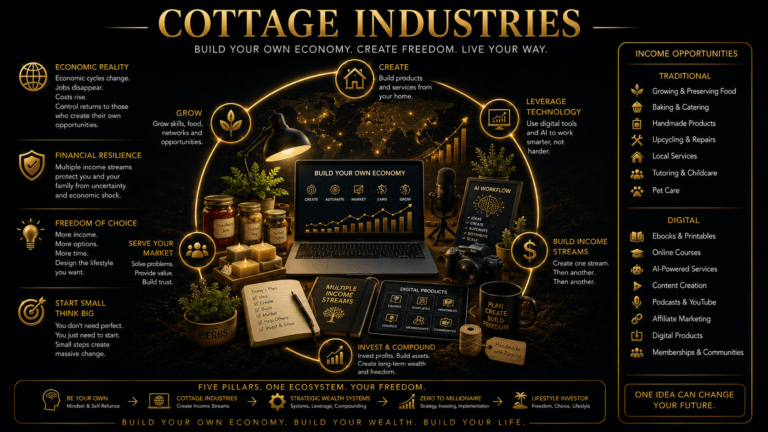
I call this the rise of Cottage Industries. Small, localised production powered by AI and technology that are run from your own home.
And it’s only just beginning.
Most People Missed The Growing Divide
We are now seeing a clear split between those adapting to AI and those continuing with outdated models. The gap between them is widening fast. One group is:
- Becoming more efficient
- More profitable
- More resilient
The other is:
- Working harder
- Spending more
- Seeing diminishing returns
The sooner you adapt to the AI influence the sooner the balance and business profit will be restored.
What This Means for You
Over the past three years, while most people missed the change, I’ve been testing this shift in real time. I’ve been refining business models that still work. Developing investment strategies that adapt to volatility and creating systems that perform in both upward and volatile markets.
The result is a different approach to business and investing. One built around:
- Systems, not tactics
- Strategy, not noise
- Adaptability, not assumption
One that comes from years of experience and knowledge within the industry.
Further Reading

Most people missed the change and won’t act on this shift. They’ll keep using the same strategies, getting the same results and wondering why nothing is working anymore.
But a small number will recognise what’s happening early.
They’ll adapt. They’ll build differently. And they’ll position themselves ahead of the curve.
If you want to be in that group, start by understanding the system behind the shift.
Explore how to build income and wealth in today’s AI-driven economy here:
Frequently Asked Questions
Has AI really changed online business that much?
Yes. It has reduced the value of information and increased the importance of execution and positioning.
Are traditional strategies still usable?
Some are but many need adapting to remain effective.
Why are markets more volatile now?
AI-driven trading increases speed and reaction time, amplifying market movements.
What are cottage industries?
Small, local production systems powered by AI and technology, reducing reliance on global supply chains.
Karen Newton Ecosystem
Glossary
For definitions of words and phrases used in this post visit the glossary

Karen Newton is a Business and Wealth Strategist, 3x #1 International Bestselling Author, Speaker and founder of Karen Newton International. She is known for helping entrepreneurs and investors connect business growth, investment opportunities, and economic trends into practical strategies for building long-term wealth and financial resilience.