Oil Past Present Future
Oil is one of the most powerful forces shaping the global economy. From transport and manufacturing to food production and household energy costs, the price of oil influences almost every sector of modern life. When oil prices rise, the effects ripple across the economy — affecting inflation, business costs, investment markets, and household budgets.
Understanding how markets work helps us make sense of economic cycles, geopolitical events, and investment opportunities. In this guide, we explore the role oil plays in the global economy, how prices are determined, and how investors can position themselves when energy markets move.
Key Takeaways
- Oil is one of the most important drivers of the global economy.
- Changes in oil prices influence inflation, transport costs, and household budgets.
- Geopolitical events often trigger sudden oil price movements.
- Energy markets follow cycles that create investment opportunities.
- Understanding oil markets helps investors anticipate broader economic trends.
Table of Contents
Why Oil Matters to the Global Economy
Oil remains the primary fuel powering the global economy. It fuels transportation systems, supports manufacturing, and plays a major role in agriculture and food production.
Almost every product in the modern world depends on energy for production and distribution. When energy prices rise, businesses face higher costs which are often passed on to consumers.
This is why economists closely monitor prices when assessing economic health.
The History of Oil and Economic Power
Oil has shaped global politics and economic power for more than a century. Major historical milestones include:
- The rise of the modern industry in the early 1900s
- The formation of OPEC in 1960
- The energy shocks of the 1970s
- The Gulf War and its impact on markets
- The shale revolution in the United States
Each of these events triggered major shifts in supply, prices, and global economic conditions.
How Oil Prices Are Determined
Oil prices are influenced by several key factors:
- Global Supply – Production levels from major producers such as the United States, Saudi Arabia, and Russia.
- Global Demand – Economic growth increases demand for energy, particularly in large economies such as China and India.
- Geopolitical Risk – Conflicts in oil-producing regions often create supply fears that push prices higher.
- Market Speculation – Traders and investors also influence oil prices through futures markets.
The Impact on Inflation
Energy prices are a major component of inflation. When oil prices rise, the cost of transportation and production increases across the economy. This often leads to higher prices for:
- fuel
- electricity
- food
- consumer goods
Central banks closely monitor prices because energy shocks can accelerate inflation.
What Happens When Prices Cross Key Levels?
Oil prices often influence the broader economy in predictable ways. Economists and investors pay close attention to certain price levels because they can signal changes in economic pressure.
While every economic cycle is different, historical patterns show that certain price ranges tend to trigger similar economic reactions.
Price Around $60–$80 per Barrel
This range is often considered a balanced price zone for the global economy. At these levels:
- Energy companies can operate profitably
- Fuel prices remain relatively stable
- Economic growth is not significantly restricted by energy costs
For many economies, this range supports steady growth without placing excessive pressure on businesses or households.
Price Around $80–$100 per Barrel
When prices moves into this range, energy costs begin to have a noticeable effect on the economy. Higher fuel costs start to influence:
- transport expenses
- airline ticket prices
- food production and logistics
- manufacturing costs
Businesses often begin passing these costs on to consumers, contributing to rising inflation.
Price Above $100 per Barrel
When prices move above $100, the economic impact becomes much more visible. At this level:
- petrol and diesel prices rise significantly
- transport costs increase across supply chains
- household energy costs rise
- inflation pressures often accelerate
Historically, sustained prices above $100 have sometimes contributed to slower economic growth as businesses and consumers adjust to higher energy costs.
Prices Above $120 per Barrel
Very high prices can create stronger economic pressure. At these levels:
- inflation may rise rapidly
- central banks may respond with tighter monetary policy
- consumer spending may slow as fuel and energy costs rise
Periods of very high prices have occasionally been associated with economic slowdowns or recessions.
Why Investors Watch Oil Closely
Prices act as an early indicator of economic pressure. Because energy is used throughout the global economy, changes in prices can influence:
- inflation trends
- interest rate decisions
- consumer spending
- business profitability
For investors, monitoring energy markets can provide valuable insight into broader economic trends.
Key Benchmarks Investors Should Know
When discussing prices, you will often hear references to different benchmarks. These benchmarks represent major pricing standards used in global markets.
Understanding these benchmarks helps investors interpret news reports and understand how energy markets are moving.
Brent Crude
Brent Crude is the most widely used global benchmark. It is produced from fields in the North Sea and is commonly used to price oil from Europe, Africa, and the Middle East.
Because Brent represents a large portion of internationally traded oil, it is often seen as the global reference price for crude.
WTI (West Texas Intermediate)
WTI, or West Texas Intermediate, is the main benchmark for oil produced and traded in the United States. It is known for its high quality and is often slightly cheaper than Brent due to regional supply dynamics.
WTI is traded heavily on futures markets and is closely watched by traders and investors.
OPEC Basket
The OPEC Basket price represents an average price of oil produced by members of the Organization of the Petroleum Exporting Countries.
Because OPEC controls a significant share of global oil supply, this benchmark helps reflect the pricing power of major oil-producing nations.
Futures
Much of the oil market operates through futures contracts. These contracts allow traders and companies to buy or sell at a predetermined price in the future.
Futures play an important role in price discovery and can influence short-term price movements as traders react to supply expectations, geopolitical events, and economic data.
Geopolitics and Supply
Many of the world’s largest oil reserves are located in politically sensitive regions. The Middle East, Russia, and parts of Africa play critical roles in global supply.
Conflicts, sanctions, and political instability can disrupt production and shipping routes, triggering sudden price spikes.
The Strait of Hormuz is one of the most important energy chokepoints in the world, with a significant portion of global oil shipments passing through the region.
The Role of OPEC
The Organization of the Petroleum Exporting Countries (OPEC) plays a central role in managing supply. By adjusting production levels, OPEC can influence global prices. Production cuts often push prices higher, while increased production can help stabilise markets.
Economic Cycles and Prices
Prices often move in cycles alongside the global economy. When economic growth is strong, demand for oil increases and prices rise. During economic slowdowns, demand falls and prices decline.
Understanding these cycles helps investors anticipate broader economic trends.
Commodities and Investment Cycles
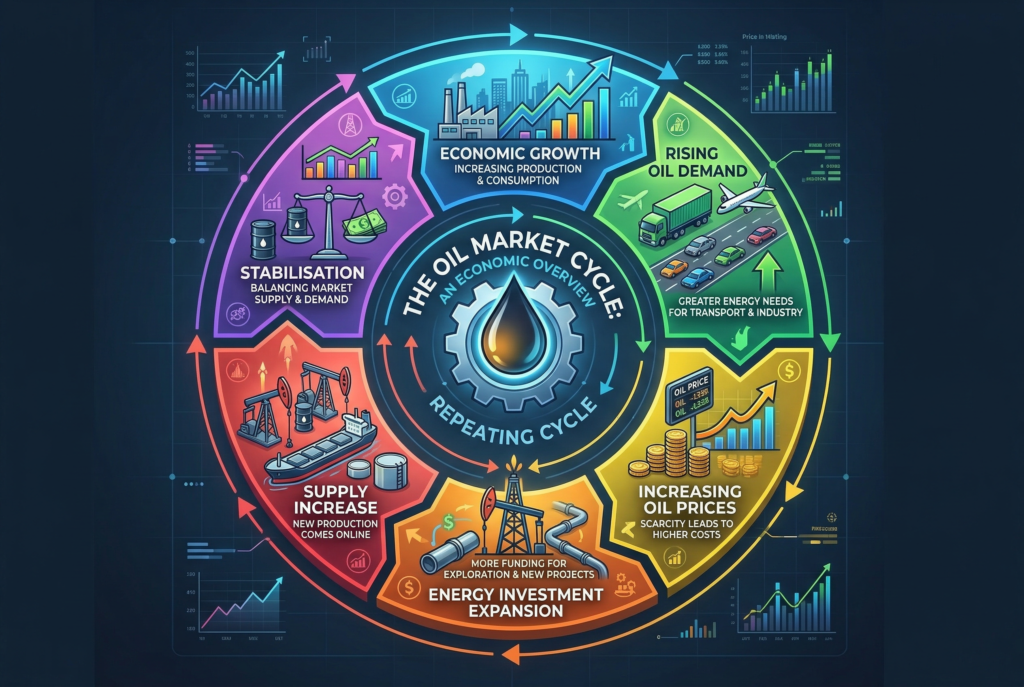
Commodity markets, including oil, tend to move in long-term cycles. These cycles are influenced by economic growth, geopolitical tensions, supply disruptions, and investment levels in energy production.
When the global economy is expanding, demand for oil increases as businesses produce more goods and transport networks become busier. This rising demand can push prices higher, particularly if supply cannot keep up.
However, higher prices often lead to increased investment in oil production. New drilling projects, exploration, and technological advances can eventually increase supply, which may push prices lower again.
These cycles are important for investors because energy markets often move ahead of broader economic trends. Rising prices can signal growing demand and economic expansion, while falling prices can sometimes indicate slowing economic activity.
By understanding these cycles, investors can better anticipate shifts in markets and position themselves accordingly.
How Investors Can Use Energy Shocks Strategically
Energy shocks, such as sudden spikes in oil prices, often occur during periods of geopolitical tension or supply disruption. While these events can create uncertainty in the short term, they also create opportunities for investors.
Historically, periods of rising energy prices have often benefited sectors such as:
- energy producers
- oil service companies
- pipeline and energy infrastructure firms
- commodity funds focused on energy markets
At the same time, higher energy costs can place pressure on industries that rely heavily on fuel, including transportation and logistics.
For investors, understanding these dynamics can help identify both opportunities and risks within the market.
Energy shocks also highlight the importance of diversification. Investors who hold a mix of assets, including commodities, shares, and other investments, may be better positioned to navigate periods of economic volatility.
Rather than reacting emotionally to short-term market movements, strategic investors focus on understanding the underlying trends that drive commodity cycles.
How Oil Impacts Households
Prices affect households in several ways:
- petrol and diesel prices
- heating and electricity costs
- food prices
- travel and transport costs
Energy price shocks can place pressure on household budgets, particularly during periods of high inflation.
Investing in Oil and Energy Markets
Energy markets offer several investment opportunities, including:
- oil companies
- energy ETFs
- commodity funds
- energy infrastructure companies
Price cycles often create opportunities for investors who understand how supply and demand influence markets.
Why Oil Still Matters in an AI and Renewable Energy World
In recent years, much attention has been focused on renewable energy, electric vehicles, and the rapid growth of artificial intelligence. These technologies are often seen as signals that the world may soon move beyond fossil fuels.
However, the reality is more complex.
Oil still plays a central role in the global economy. While renewable energy is expanding rapidly, many industries remain heavily dependent on oil, including aviation, shipping, manufacturing, and agriculture. Even technologies designed to reduce emissions, such as electric vehicles, batteries, and solar panels, require energy-intensive manufacturing processes and global supply chains that rely on oil-powered transportation.
Artificial intelligence is also increasing global energy demand. Large data centres, cloud computing infrastructure, and AI processing systems require significant amounts of electricity and cooling systems. Meeting this demand requires a diverse mix of energy sources.
For this reason, energy transitions tend to take decades rather than years. Historically, new energy sources have supplemented existing ones rather than replacing them immediately.
Understanding this transition is important for investors and businesses. While renewable energy and new technologies will play a growing role in the global economy, oil is likely to remain a significant part of the energy mix for many years to come.
Rather than disappearing overnight, the energy system is evolving — and periods of transition often create both risks and opportunities in global markets.
The Future of Oil
While renewable energy is growing rapidly, oil continues to play a major role in the global energy system.
Even as economies transition toward cleaner energy sources, oil will likely remain a critical component of the global economy for decades.
Understanding energy markets will remain important for investors, businesses, and households alike.
Economic Recessions
Throughout modern economic history, sharp increases in oil prices have often been associated with economic slowdowns.
When energy costs rise quickly, businesses face higher operating expenses while households must allocate more of their budgets to fuel and energy. This leaves less money available for discretionary spending, which can slow economic growth.
Several historical recessions have been preceded by significant price shocks, including:
- The 1973 oil crisis
- The 1979 energy crisis
- The 2008 oil price spike before the financial crisis
While prices alone do not cause recessions, sudden increases in energy costs can place additional strain on already fragile economic systems.
Understanding these patterns helps investors interpret warning signals within the global economy.
Global Supply Chains
Oil plays a critical role in global trade and supply chains. Nearly every product sold around the world depends on transportation at some stage of production or distribution. Oil fuels cargo ships, trucks, airplanes, and heavy machinery used in manufacturing and agriculture.
When prices rise sharply, the cost of transporting goods also increases. These higher costs are often passed through the supply chain, eventually reaching consumers in the form of higher prices.
This is why energy price shocks can influence everything from supermarket food prices to the cost of building materials.
Geopolitical Power
Energy resources have long been closely linked to geopolitical influence. Countries with large oil reserves often play significant roles in global politics because energy supply is essential for economic stability.
Major oil-producing regions such as the Middle East, Russia, and parts of North America influence global markets through production decisions, political alliances, and strategic partnerships.
Energy supply disruptions caused by conflict, sanctions, or political instability can trigger rapid changes inl prices and global economic conditions.
Because of this, energy markets are often one of the first places investors look when geopolitical tensions rise.
Transition to Renewable Energy
Many governments around the world are investing heavily in renewable energy technologies such as solar, wind, and battery storage. This transition is driven by environmental concerns, energy security, and technological innovation.
However, energy transitions historically take many decades. Even as renewable energy capacity grows, oil continues to play a major role in sectors that are difficult to electrify, including aviation, shipping, heavy industry, and agriculture.
Rather than disappearing suddenly, oil is likely to remain part of a diversified global energy system for many years to come.
Understanding this gradual transition helps investors avoid oversimplified narratives about the future of energy markets.
Why Energy Markets Matter for Investors
Energy markets influence many other parts of the financial system. Changes in oil prices can affect:
- inflation trends
- interest rate policy
- stock market performance
- commodity markets
- business profitability
Because energy costs are embedded throughout the economy, prices often act as an early signal of changing economic conditions.
Investors who monitor energy markets closely can often gain insight into broader economic trends before they appear in other indicators.
Understanding how commodities interact with economic cycles can help investors position themselves more effectively during periods of market volatility.
Frequently Asked Questions
Why does oil have such a big impact on the economy?
It powers transportation, manufacturing, and global supply chains. Changes in prices affect production costs across many industries.
Why do oil prices rise during wars?
Conflicts often disrupt production or shipping routes, reducing supply and pushing prices higher.
What happens when oil prices rise above $100?
Higher prices can increase inflation, raise fuel costs, and slow economic growth.
Does oil affect food prices?
Yes. Agriculture depends heavily on fuel for machinery, fertilisers, and transport.
Can investors profit from rising oil prices?
Energy companies and commodity funds often benefit during periods of rising prices.
Learn More About Economic Trends
Energy markets play a major role in shaping economic cycles and investment opportunities. Understanding how commodities like oil influence the global economy can help investors make better long-term decisions.
If you want to learn more about economic trends, investing strategies, and building financial resilience, explore the Zero to Millionaire Wealth Strategy and discover how to position yourself during changing market conditions.
Economic Commentary
While this guide explains the long-term role commodities play in the global economy, real-world markets are constantly evolving. Our Economic Commentary provides regular insights into how current events and economic developments are influencing commodity prices and investment trends.
Karen Newton Ecosystem





Glossary
Definitions of words and phrases used in the post are available in the Glossary

Karen Newton is a Business and Wealth Strategist, 3x International Bestselling Author, and founder of Karen Newton International. She combines practical experience with AI-Powered Entrepreneurship to help smart entrepreneurs build online income, invest strategically, and create long-term wealth through business growth, investments and joint ventures.