UK Inflation Rises
UK inflation is back in the headlines. The latest reports put Consumer Price Index inflation at 3.1%, up from 2.9%, once again moving further above the Bank of England’s 2% target. On its own, that is simply another economic statistic. But nothing happens in isolation.
Over the past few months, I’ve written about energy, government debt, bond markets, property, household finances, liquidity and defensive investing. Each article looked at a different part of the economic landscape.
Now we are beginning to see how some of those individual pieces connect. Inflation isn’t necessarily the beginning of this story. It may simply be the next ripple.
Key Takeaway for UK Inflation
- UK Inflation rising to 3.1% isn’t an isolated headline. It is another ripple in a much wider economic system connecting energy costs, business prices, interest rates, bond markets, government borrowing, property and household finances.
- The aim isn’t to predict exactly what happens next. It is to recognise the connections, understand the possible consequences and watch for the next signal.
Newton’s Law of Connection: Nothing Happens in Isolation. Observation → Interpretation → Action.
Table of Contents
The Ripple Effect in Action
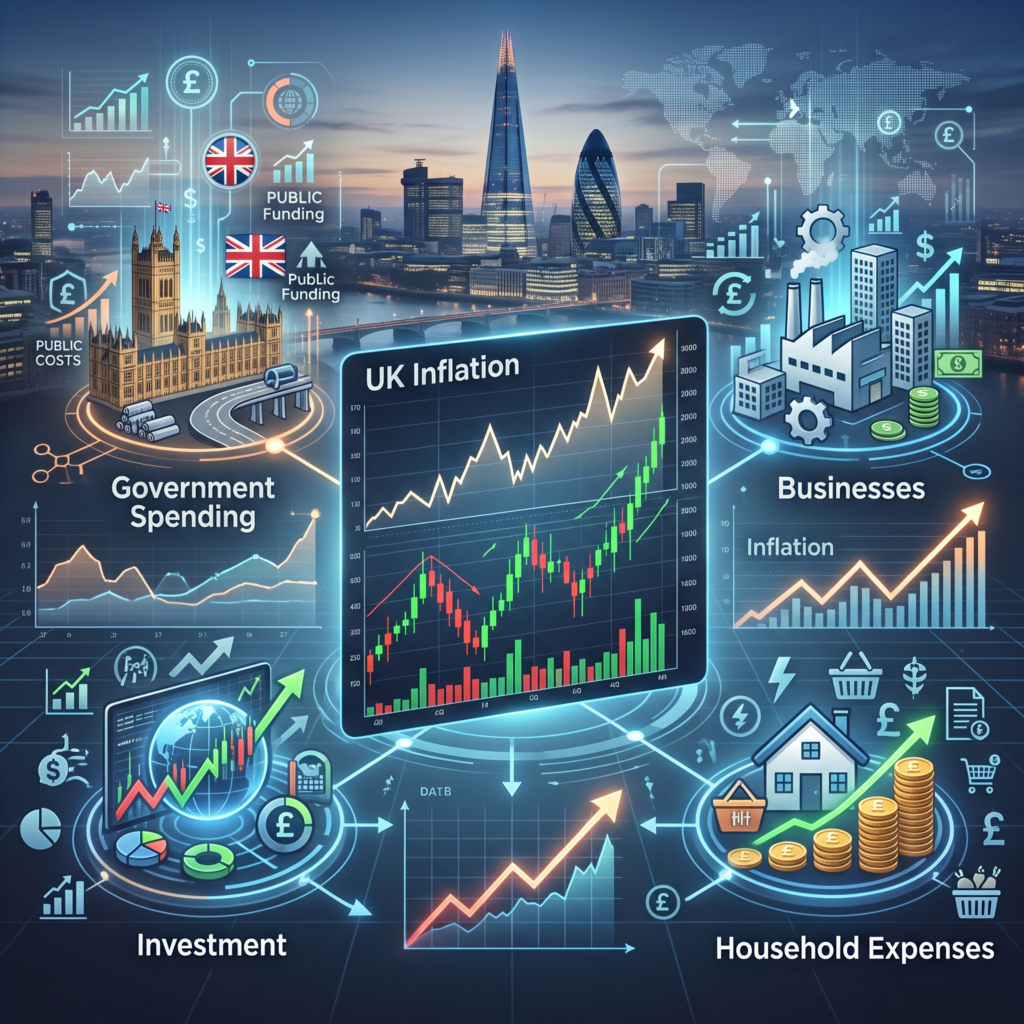
One of the biggest mistakes we can make when looking at markets and the economy is treating every headline as an isolated event. Everything is interconnected
- Oil prices rise.
- Government borrowing becomes more expensive.
- Inflation increases.
- Interest rates change.
- Mortgage payments rise.
- Consumers change their spending habits.
- Businesses see their costs increase.
- Governments change taxation or spending.
These can appear to be separate stories when they arrive in our news feeds on different days. But they are connected. That is the principle behind The Ripple Effect. An event occurs somewhere in the economic system. The initial impact creates another effect somewhere else. That creates another, and another.
The important part for investors and business owners isn’t trying to predict every ripple perfectly. It is recognising the connections.
We’ve Been Watching the Ripples Develop
Regular readers of my Business and Wealth Strategy Commentary will recognise many of the components of the current situation. We’ve looked at:
- liquidity and what happens when money becomes more expensive or less readily available.
- Property Signals and the pressures created when borrowing costs, affordability and consumer confidence begin changing.
- the North Sea and the wider implications of energy policy and energy security.
- More recently, in When Government Debt Becomes Expensive, we looked at what happens when governments have to pay more to borrow.
- And in Defensive Investing, we looked at why building resilience into an investment strategy matters before we know exactly what the next economic event will be.
At the time, these were individual observations. Today, we can start connecting them.
Energy Doesn’t Stay in the Energy Market
One of the most obvious examples of the Ripple Effect is energy. Higher oil and gas prices don’t only affect the amount we pay to fill a car or heat a home.
Energy is involved in producing, transporting, storing and selling almost everything we consume.
A manufacturer pays more to operate machinery. A logistics company pays more to transport goods. A supermarket faces increased refrigeration, transport and supplier costs. A restaurant sees its electricity, ingredients and delivery costs change.
Eventually, somebody has to absorb those increases. Sometimes the business absorbs them through lower margins. Sometimes efficiencies are found elsewhere. Sometimes the customer pays more. Usually, there is a mixture of all three.
The Bank of England has already been watching this process. Its July Monetary Policy Report said inflation was expected to rise during the second half of 2026 as higher global energy prices worked their way into UK consumer prices.
Importantly, the Bank distinguished between the direct effects of higher energy costs and the indirect effects as businesses pass higher costs through supply chains. It forecast CPI inflation averaging around 3.2% in the fourth quarter of 2026.
That is the Ripple Effect. An energy shock doesn’t remain an energy shock. It travels.
Some Ripples Take Time
This is another important part of understanding economic signals. The effect isn’t always immediate.
Businesses may have fixed-price contracts. They may have hedged energy costs. Retailers may temporarily accept smaller margins rather than increase prices. Companies may have existing inventory purchased before costs increased. That creates a delay between the original event and the eventual impact on the consumer.
The Bank of England’s September survey of business conditions provides an interesting example.
It found that input costs and consumer prices were continuing to edge higher. Businesses had been finding efficiencies and passing some increased costs to customers, but the Bank also noted that some increases currently cushioned by hedges or fixed contracts could still be passed into prices during 2027.
In other words, some of the ripple may still be travelling through the system. That matters because today’s inflation number doesn’t necessarily tell us where inflation goes next.
We need to continue watching the signals.
Newton’s Law of Connection
This brings me to one of the principles I’ve been developing as part of Newton’s Laws of Business & Wealth:
Nothing Happens in Isolation.
- Business owners sometimes look at business.
- Property investors look at property.
- Share investors look at the stock market.
- Homeowners look at mortgage rates.
- Consumers look at supermarket prices.
- Governments look at taxation and borrowing.
But the economy doesn’t divide itself into those convenient boxes. They interact.
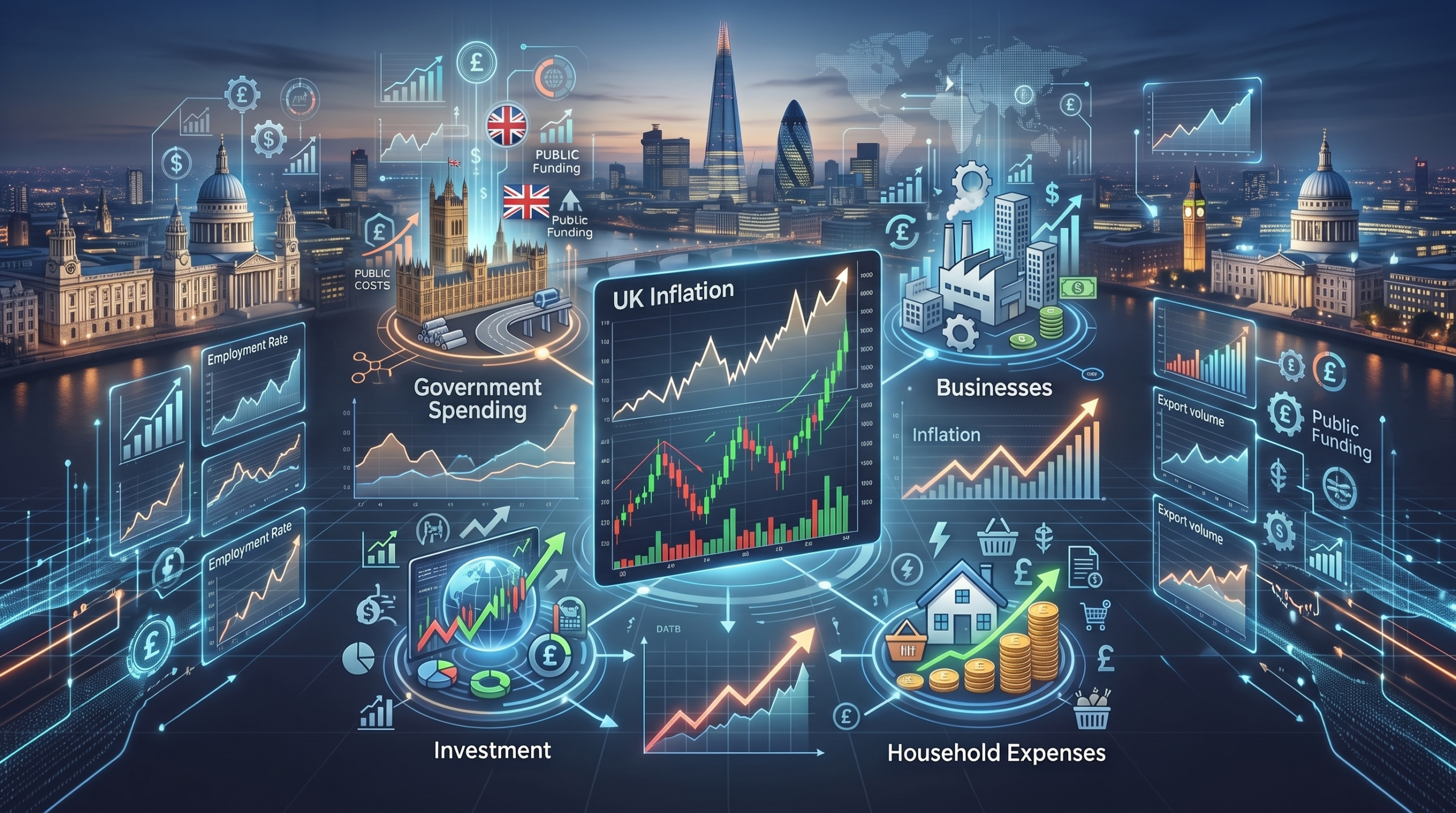
A change in energy prices can affect inflation. Inflation can influence interest-rate expectations. Interest-rate expectations can affect bond yields. Bond yields can change government borrowing costs. Higher government borrowing costs can influence future decisions about taxation and spending. Interest rates can affect mortgages and property affordability. Mortgage payments can change household disposable income. Changes in disposable income can alter consumer spending. Consumer spending affects businesses. Business profitability affects investment and employment.
And around the system we go again.
Nothing happens in isolation.
Once we start looking for the connections rather than simply reacting to individual headlines, economic news begins to look very different.
So What Could the Next Ripple Be?
This is where Observation → Interpretation → Action becomes important.
We have an observation: inflation has moved higher.
Our interpretation is that some of the pressures we’ve been watching may now be travelling further through the economic system.
The next step isn’t to announce confidently what happens next. It is to identify what we should be watching.
There are several possibilities.
1. Interest Rates
The obvious place to start is the Bank of England.
Bank Rate currently stands at 3.75%.
At its July meeting, six members of the Monetary Policy Committee voted to keep rates unchanged. But three members voted to increase Bank Rate to 4%.
That doesn’t mean an interest-rate rise is inevitable. It tells us something much more useful: there is already disagreement within the committee about how much monetary restraint is required.
The Bank has also said that the longer higher energy prices persist, the greater the risk that they create what economists call second-round effects. That’s where an initial price shock begins influencing wider prices and wages and potentially makes inflation more persistent.
The Bank of England announces its next interest-rate decision on 17 September. So this is one of the first ripples to watch. The question isn’t simply: Will interest rates rise? A better question is: What does the Bank’s decision and accompanying commentary tell us about how it sees inflation developing from here?
2. The Bond Market
Then we have government bonds. We’ve already discussed this in When Government Debt Becomes Expensive. Governments borrow money by issuing bonds.
If investors demand higher yields to lend to the government, the cost of servicing government debt can increase. Inflation expectations and interest-rate expectations are among the factors that can influence bond markets.
That means today’s UK inflation story potentially reconnects with the government debt story we’ve already been following.
Again, the important signal isn’t one day’s movement in gilt yields.
We are watching the direction and the relationship between inflation expectations, monetary policy and government borrowing costs.
3. Government Spending and Taxation
And that brings us to government finances. If borrowing becomes more expensive, governments face choices. They can:
- borrow more.
- reduce expenditure.
- increase taxation.
- change fiscal priorities.
Or they can use some combination of these. That doesn’t mean today’s inflation figure automatically leads to tax rises. It means the fiscal pressure becomes another ripple worth monitoring.
When we hear speculation about future Budgets, spending cuts or taxation, rather than treating them as isolated political announcements, we can ask what happened earlier in the chain? That question often provides much more useful information.
4. Property and Household Finances
Interest rates eventually find their way into household finances. Not everyone feels the impact immediately. A homeowner with a fixed-rate mortgage may initially notice very little. Someone refinancing may experience something completely different. Landlords face financing and operating costs. Developers depend heavily on the availability and price of capital. Buyers depend on affordability.
Those factors can influence transaction volumes, property prices, rents and development activity. This takes us straight back to the Property Signals we’ve already been monitoring.
Again, nothing happens in isolation.
5. Businesses and Consumers
Perhaps the most important ripple is also the easiest to overlook. What happens to the consumer?
If households spend more on energy, food, mortgages, rent or taxation, there may be less disposable income available for everything else. That becomes a business signal.
A household reducing discretionary spending doesn’t appear in the economic statistics as an abstract theory. It appears as fewer restaurant visits. A postponed holiday. A delayed car purchase. Less money spent on clothing. Cancelled subscriptions. Different supermarket choices.
Those individual decisions eventually appear in company revenues, employment decisions, investment plans and economic growth.
The ripple travels again.
This Is Why I Don’t Try to Predict Markets
There is an important distinction between identifying a possible ripple and predicting that it will happen.
- I don’t need to know whether the Bank of England will increase interest rates.
- I don’t need to predict exactly where inflation will be in six months.
- I don’t need to know what the next Budget will contain.
I need to understand the system well enough to recognise what could happen and ensure my business and investment strategies aren’t dependent upon one particular outcome.
That is a very different approach. It’s also why I’ve spent so much time talking about Defensive Investing.
A defensive strategy isn’t created when markets become difficult. The defensive characteristics should already be part of the system. Different assets and strategies perform different jobs under different conditions.
The aim isn’t to correctly predict every economic event. It is to Build the System, Trust the System and continue observing what is changing around it.
Observation → Interpretation → Action
That brings us back to the framework I use when looking at markets.
Observation
UK Inflation has moved higher again. Energy and input costs remain an important part of the economic picture.
Interpretation
This isn’t an isolated inflation statistic. It potentially connects with several trends we’ve already been watching: energy prices, business costs, interest rates, government borrowing, property affordability and household finances.
Some of those effects may take months to work through the system.
Action
Watch the next signals.
- What does the Bank of England do with interest rates?
- How does the bond market react?
- What happens to government borrowing costs?
- Do businesses continue passing costs to consumers?
- What happens to mortgage affordability and the property market?
- Does household spending begin changing?
- And what fiscal choices emerge as these different pressures interact?
We don’t need to predict the answers. We need to recognise their significance when they arrive.
The Next Ripple
The Bank of England is due to announce its next interest-rate decision. Whatever that decision is, it becomes another observation. If rates remain unchanged, we look at why. If rates change, we look at why.
We then interpret what that information tells us about inflation, economic growth and the pressures travelling through the system.
And we watch for the next ripple. Because the real value of understanding the Ripple Effect isn’t being able to say “I told you this would happen.” It is being able to say “We’ve been watching the conditions that could make this happen. Now let’s understand what it means and what could come next.”
That is the difference between reacting to headlines and interpreting markets.
And it is why Newton’s Law of Connection matters: Nothing Happens in Isolation.
The headline may be UK inflation. But the story is much bigger.
Further Reading



Podcast and Video Library
Frequently Asked Questions
Why is UK inflation rising?
Inflation can rise for several interconnected reasons, including energy costs, transport, wages, production costs and businesses passing higher costs through to consumers. This is why inflation should be viewed as part of a wider economic system rather than as an isolated figure.
Does higher UK inflation mean interest rates will rise?
Not necessarily. The Bank of England considers inflation alongside economic growth, employment, wages and other economic data when setting interest rates. The important signal is not only the interest-rate decision itself, but also what the Bank says about inflationary pressures and the outlook ahead.
How can inflation affect households and businesses?
Inflation can increase everyday costs for households and operating costs for businesses. It can also influence interest rates, mortgages, property, consumer spending and investment decisions — demonstrating Newton’s Law of Connection: Nothing Happens in Isolation.
Follow the Next Ripple
Markets rarely move in isolation. One change creates another across interest rates, property, businesses, investments and household finances.
In Strategic Investor Brief – The Ripple Effect, I take the signals we are seeing today and explore what they could mean next, turning Observation → Interpretation → Action.
If you’d like to continue following the connections beyond this article, you can subscribe to Strategic Investor Brief – The Ripple Effect and receive the next brief directly in your inbox.
Karen Newton Ecosystem


Karen Newton is a Business and Wealth Strategist, 3x #1 International Bestselling Author, Speaker and founder of Karen Newton International. She is known for helping entrepreneurs and investors connect business growth, investment opportunities, and economic trends into practical strategies for building long-term wealth and financial resilience.