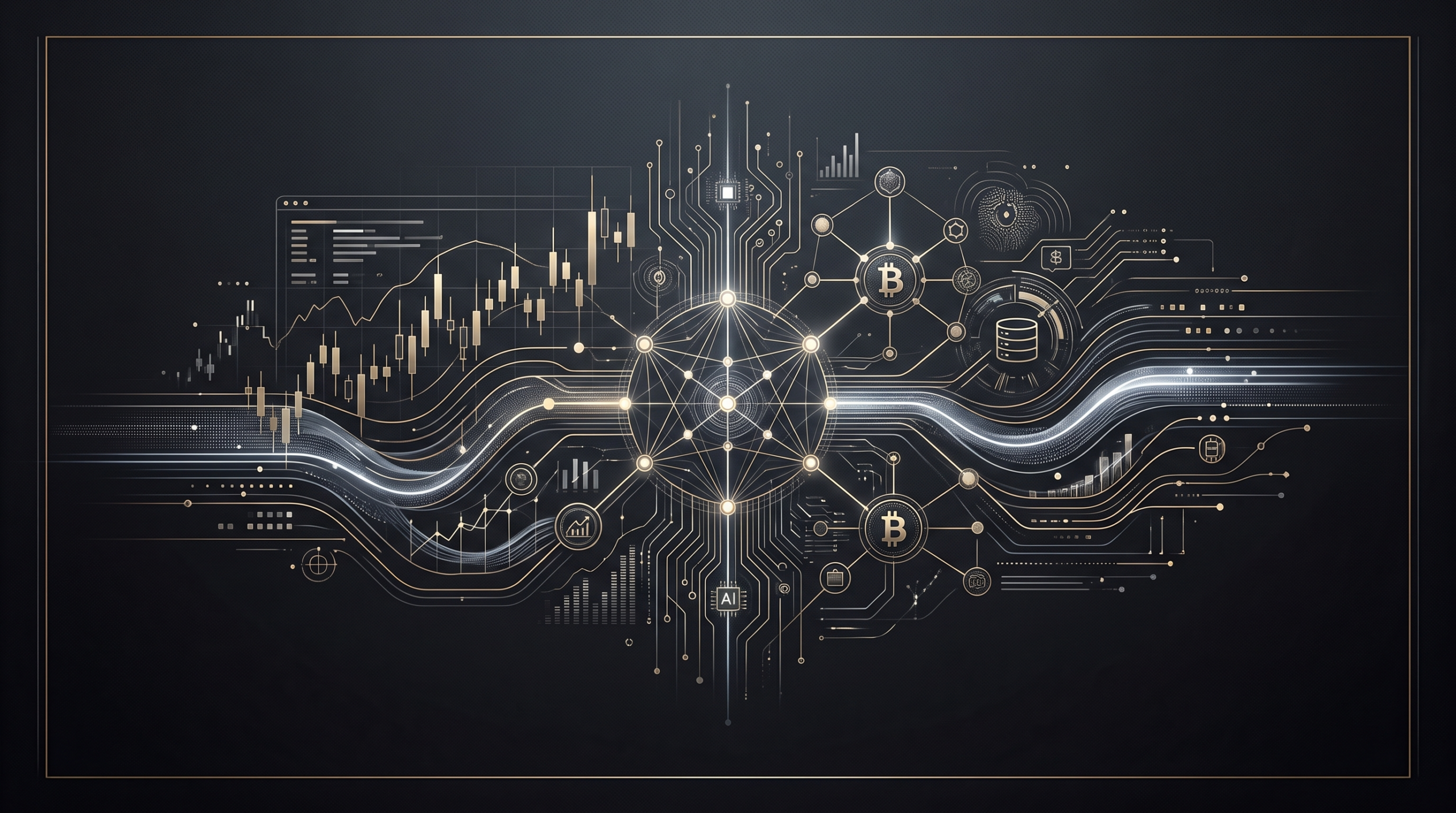
Programmable Financial Markets
When Financial Markets become programmable, what happens next?
The US Securities and Exchange Commission has opened the door to something that could ultimately change the way we think about share trading.
On 17 September 2026, the SEC announced a temporary five-year “Innovation Exemption” allowing qualifying Tokenized Securities Venues to facilitate trading in tokenised US National Market System stocks using permissioned automated market makers and liquidity pools.
Importantly, qualifying tokenised shares must provide holders with the same rights and privileges as the equivalent traditional shares. The SEC also requires trading to stop if trading in the underlying stock is halted on its primary exchange.
This isn’t the wholesale replacement of traditional stock exchanges. It is a controlled experiment designed, in part, to allow the SEC to observe how tokenised and traditional markets interact before considering longer-term regulation.
On the surface, this is a story about blockchain technology entering traditional share markets. But I think the more interesting story could be the Ripple Effect. Because nothing happens in isolation.
Key Points Programmable Financial Markets
- Tokenised share trading is moving into regulated markets. The SEC’s five-year Innovation Exemption creates an environment in which blockchain-based share trading can develop alongside traditional markets.
- 24/7 share trading becomes a possibility, not a certainty. If markets increasingly move onto blockchain infrastructure, conventional trading hours could eventually become less important.
- AI could become increasingly important in continuous markets. Machines can monitor and respond to global markets when human investors cannot.
- Speed could change volatility. Multiple AI systems reacting simultaneously to news, prices and each other could amplify some short-term market movements, although automation could also improve liquidity and efficiency.
- Bitcoin’s future role may extend beyond being a currency. Saylor’s vision raises the possibility of Bitcoin operating more like digital capital or collateral beneath other financial products.
- Easy access doesn’t mean simple investments. AI and blockchain could make sophisticated financial products easier to use while making the underlying infrastructure more complex.
- Headline yield isn’t the whole story. An 8% return only becomes meaningful when you understand how it is generated, the risks involved and how it fits within the wider investment strategy.
- Nothing Happens in Isolation. Tokenisation, AI, Bitcoin, digital credit and changing investor behaviour may look like separate developments, but the connections between them could ultimately matter more than any individual headline.
Table of Contents

Shares Move Onto the Blockchain
A tokenised security is essentially a security whose ownership is represented or recorded, at least partly, through a crypto network.
Earlier this year, the SEC outlined several ways securities could be tokenised. Some can represent the actual security, while other structures created by third parties may provide different rights or simply synthetic exposure to the underlying asset. That distinction matters.
The latest SEC exemption requires eligible tokenised stocks traded through these venues to provide the same rights and privileges as their traditional equivalent. Why is that potentially significant?
Traditional share trading relies on an established infrastructure involving brokers, exchanges, clearing, settlement, custody and ownership records.
Blockchain potentially changes some of that infrastructure by allowing ownership and transactions to be recorded on-chain.
The SEC itself identifies issuance, trading, transfer, settlement and recording ownership as areas where tokenisation could potentially modernise market infrastructure. That doesn’t mean the existing system disappears tomorrow. But it does raise an interesting question.
What happens when traditional financial assets increasingly operate on infrastructure originally associated with crypto?
And that leads to another question.
What Happens When the Market Never Closes?
Traditional stock exchanges have opening and closing times. Blockchain doesn’t need to sleep. That doesn’t mean the SEC announcement has suddenly created 24/7 US share trading. It hasn’t.
But once financial assets are operating on blockchain infrastructure, the possibility of much longer trading hours becomes interesting.
We already live in an interconnected global economy. An investor in Europe can own American shares while events in Asia affect the companies they own. News doesn’t conveniently arrive between 9:30am and 4:00pm New York time. So what happens if markets increasingly don’t need to wait either?
We could eventually move towards an environment where price discovery takes place much closer to the time an event occurs rather than waiting for the primary market to reopen. That could alter the importance of overnight price gaps. But it creates another problem.
Markets might be able to operate 24 hours a day. Human beings can’t.
AI Doesn’t Need to Sleep
An international investor trying to monitor a genuinely continuous global market manually would rapidly discover the limitations of being human. Artificial intelligence doesn’t have that problem.
AI can monitor markets continuously, analyse information and execute predetermined instructions far faster than a human investor. That could make AI and automated trading increasingly important if trading hours expand.
But there is an enormous difference between telling an AI – Monitor these investments, follow these risk parameters and alert me when these specific conditions occur – and simply saying – AI, trade for me. The difference is the system behind the instruction. It all comes down to the parameters set. An AI can execute a badly designed strategy just as efficiently as it can execute a good one.
Speed doesn’t replace understanding. And as AI makes sophisticated trading increasingly accessible to ordinary investors, that distinction could become much more important.
When Thousands of AIs React at Once
There is another potential consequence in the Financial Markets. AI can respond to information considerably faster than a human investor. Imagine an unexpected economic announcement.
- An AI system reads it, interprets the potential consequences and executes a trade.
- The resulting price movement is detected by another automated system.
- That system responds.
- The increase in volatility triggers another system’s risk parameters.
- More trades follow.
We could potentially see: Event → AI Interpretation → Automated Trade → Price Movement → Algorithmic Response → Further Price Movement
Now multiply that across thousands or potentially millions of automated systems. Could that increase short-term volatility? Possibly. Could automated market makers and AI also improve liquidity and correct pricing discrepancies faster? Also possibly.
The SEC’s current experiment specifically permits the use of permissioned automated market makers and liquidity pools, so we are going to have an opportunity to observe how some of this new infrastructure actually behaves rather than simply theorising about it.
That’s why I don’t think we need to predict the outcome. We need to watch it.
The Investor Paradox: Easier Access, Less Understanding
Technology has a habit of removing friction. That is normally considered progress. But removing the difficulty of doing something doesn’t necessarily remove the risk associated with doing it.
AI could make sophisticated investing available to people who previously wouldn’t have known how to execute those strategies themselves.
Tokenisation could make financial assets easier to divide, transfer and integrate with other digital financial products.
Eventually, the interface presented to the investor could become extraordinarily simple. But the infrastructure underneath it could become extraordinarily complicated.
That creates an interesting paradox products on Financial Markets could become simpler than ever to use while the machinery underneath them becomes more complicated than ever to understand.
And that brings me to another headline that caught my attention.
Michael Saylor, Bitcoin and the 8% Bank Account
Michael Saylor recently suggested we’re heading towards a world where billions of people will want a bank account paying around 8% annually. His broader argument is that digital money could ultimately be built on top of Bitcoin. Whether that vision becomes reality remains to be seen.
But it made me reconsider a question I’ve had about Bitcoin for some time. Bitcoin has a maximum supply of 21 million coins. If Bitcoin were eventually adopted around the world, how could there possibly be enough Bitcoin to support billions of people?
Of course, Bitcoin itself is highly divisible. But there is another way of looking at the question. What if billions of people don’t actually need to use Bitcoin directly?
What If Bitcoin Becomes the Underlying Asset?
Gold provides an interesting analogy. The global financial system doesn’t require everyone to carry gold coins around in their pockets.
Gold can instead be held as a reserve asset while currencies and financial instruments operate above it.
What if Bitcoin eventually develops a similar role within parts of the digital financial system?
Instead of thinking Bitcoin → Consumer → Payment we could potentially have
- Bitcoin / Digital Capital
↓
Digital Credit
↓
Digital Money and Financial Products
↓
Consumers
That changes the concept of Bitcoin considerably. Instead of asking whether everyone will eventually spend Bitcoin, the question becomes whether Bitcoin could increasingly be used as an underlying asset or collateral within a much larger digital financial infrastructure. That doesn’t mean it will happen.
Bitcoin remains volatile, and any credit system built around volatile collateral has risks that would need to be managed. Nor is Bitcoin the only possible asset upon which future digital financial products could be constructed.
But it changes the question. And we may already be seeing some of the foundations that would be necessary for greater integration between Bitcoin and conventional finance.
Traditional Finance and Digital Finance Are Already Connecting
Bitcoin exchange-traded products have already created one bridge between conventional investment markets and Bitcoin. Investors don’t necessarily need to understand wallets or private keys to gain regulated market exposure to Bitcoin through traditional investment infrastructure.
Now we’re seeing the movement potentially happening in the opposite direction. Traditional shares are beginning to move onto blockchain infrastructure. So perhaps we shouldn’t think purely in terms of Traditional Finance versus Digital Finance. The more interesting possibility may be Traditional Finance + Digital Finance.
- Shares become tokenised.
- Digital assets enter traditional investment products.
- AI monitors and potentially executes transactions.
- Money becomes increasingly programmable.
The boundaries begin to blur. And that is where Michael Saylor’s 8% proposition becomes interesting for another reason.
The Seduction of 8%
Tell someone they can earn 3%, 5% or 8%, and many people will naturally look at the biggest number. 8% must be better than 5%. But yield alone tells us very little about the quality of an investment.
- Where does the 8% come from?
- What risk is being taken to generate it?
- What collateral sits underneath it?
- How liquid is the investment?
- How frequently is the return received?
- Can the return be regularly reinvested?
- What happens to the underlying capital when markets move against it?
Those questions matter to me because my own approach has increasingly become Less Is More.
I’m not automatically interested in the highest headline return. I’m interested in the system.
A lower return over a shorter period with regular opportunities to reinvest may provide attractive compounding characteristics. Equally, a higher headline yield may still be the better proposition in some circumstances. The number alone doesn’t tell us.
We have to understand how the return is generated and what risks we’re accepting in exchange for it. That becomes even more important if financial products become increasingly complex underneath increasingly simple interfaces.
Imagine eventually being offered:
- Digital Account — Earn 8%
- Opening it might take seconds.
- Understanding everything happening underneath that 8% could take considerably longer.
Technology can simplify access. It cannot remove the need to understand risk.
Newton’s Law of Connectivity
This is where the individual headlines become much more interesting to me. The SEC announcement looks like a story about tokenised shares. Michael Saylor’s comments look like a story about Bitcoin. AI trading looks like a technology story. 24/7 markets look like a trading story.
But what happens when we connect them?
- Tokenised Shares
↓
Potential Longer or 24/7 Markets
↓
Greater Need for Automation
↓
AI Trading
↓
Changing Liquidity and Volatility
↓
Changing Investor Behaviour
At the same time:
- Bitcoin
↓
Institutional Integration
↓
Potential Digital Collateral
↓
Digital Credit
↓
Digital Financial Products
Eventually those two chains could begin interacting. That’s the Ripple Effect. And it’s why Newton’s Law of Connectivity matters:
Nothing Happens in Isolation.
Reading each headline individually tells us what happened. Connecting the headlines can help us think about what those developments might mean together. That doesn’t mean every connection will ultimately prove important. Observation isn’t prediction.
It’s about recognising changes, interpreting the potential connections and then watching for evidence that either supports or challenges the original interpretation.
Observation → Interpretation → Action
Observation
The SEC has created a temporary regulatory pathway allowing certain tokenised US shares to trade on-chain.
Bitcoin is increasingly connected with conventional financial infrastructure.
AI is becoming increasingly capable of monitoring, interpreting and interacting with financial markets.
Individually, none of these developments tells us what the financial system will look like ten years from now.
Together, they’re worth watching.
Interpretation
We could be witnessing the early stages of a financial system in which the traditional boundaries between shares, crypto, banking, payments and investment infrastructure become increasingly difficult to distinguish. The future of investing may not simply be digital. It may be programmable.
And paradoxically, the easier that system becomes to access, the more important understanding what sits underneath it could become.
Action
This is where Observation and Interpretation need to become practical. What should investors actually watch next?
What signals could indicate that tokenisation is moving from an experiment towards mainstream financial infrastructure?
How should investors think about AI, liquidity, volatility, digital yield and risk as these systems evolve?
And perhaps most importantly Does anything within an investment strategy actually need to change?
That’s where I move from Interpretation to Action in this week’s Strategic Investor Brief – The Ripple Effect.
Because Action doesn’t always mean changing something. Sometimes the right Action is knowing what to watch, what matters and what would need to happen before you act.
Observe the change. Interpret the connection. Then decide whether Action is necessary.
Build the System. Trust the System.
Further Reading


Podcast and Video Library
Frequently Asked Question – Financial Markets Digitalised
What are tokenised shares?
Tokenised shares are securities whose ownership is represented or recorded using blockchain technology. Depending on how they are structured, a token may represent the actual underlying security and its associated rights, or provide exposure to its value. Investors therefore need to understand exactly what a particular token represents.
Could blockchain lead to 24/7 stock market trading?
Potentially. Blockchain infrastructure can operate continuously, removing some of the technical limitations associated with traditional market hours. However, 24/7 trading of mainstream shares is not guaranteed. Regulation, liquidity, settlement arrangements and market participation will all influence how trading hours develop.
How could AI affect share trading and market volatility?
AI can monitor information and react to changing market conditions much faster than human investors. This could improve liquidity and market efficiency, but it could also contribute to short-term volatility if large numbers of automated systems respond to the same signals simultaneously. The outcome will depend heavily on how those systems are designed and the parameters governing their decisions.
Karen Newton Ecosystem


Karen Newton is a Business and Wealth Strategist, 3x #1 International Bestselling Author, Speaker and founder of Karen Newton International. She is known for helping entrepreneurs and investors connect business growth, investment opportunities, and economic trends into practical strategies for building long-term wealth and financial resilience.