Government Debt
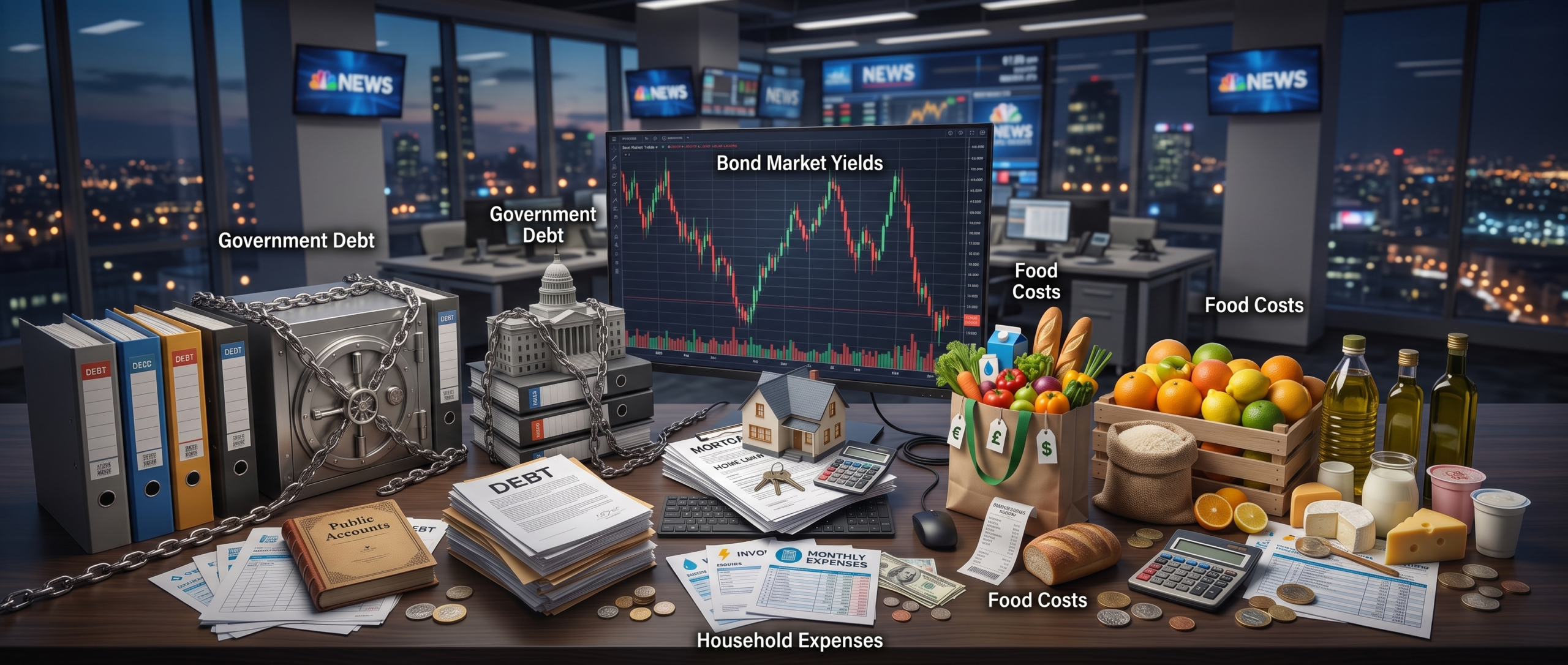
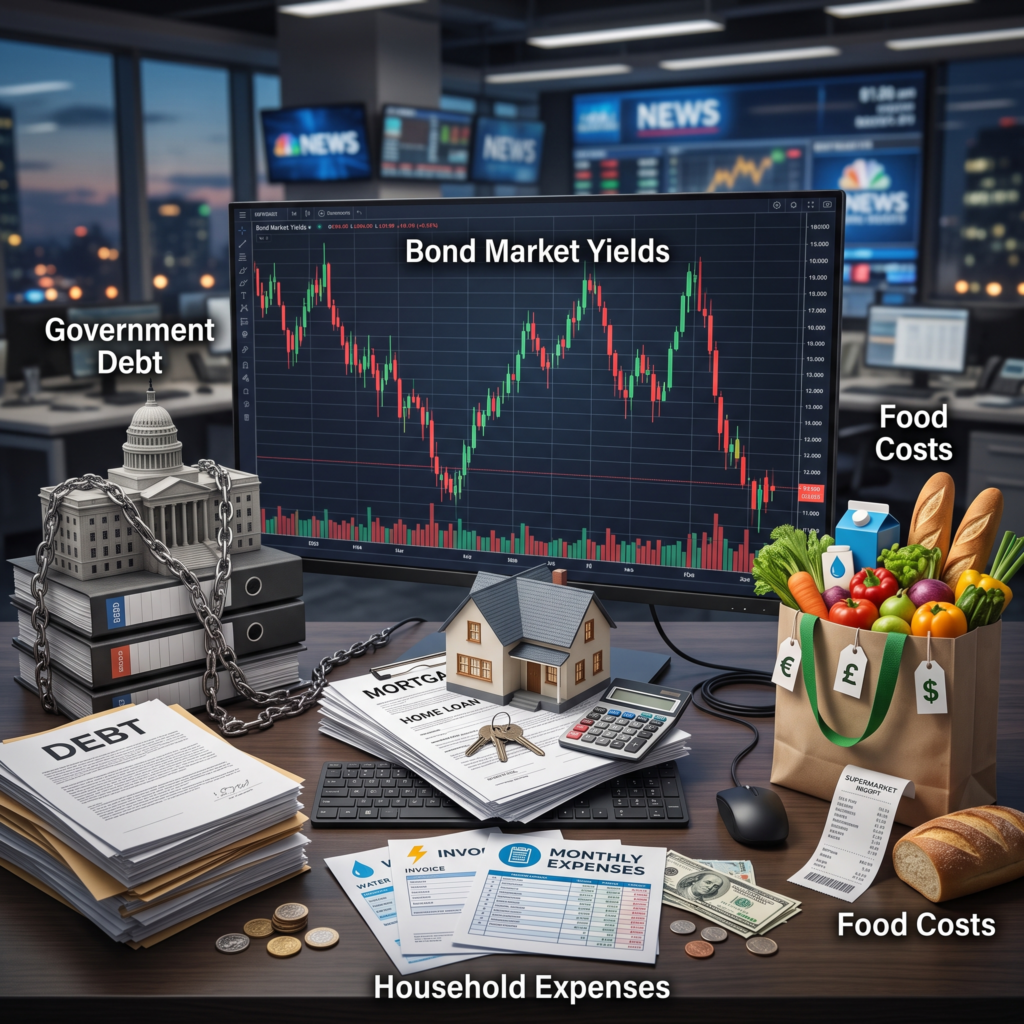
When Government Debt Gets Expensive it’s time to look at the Ripple Effect from Bond Markets to your household living costs.
Most people don’t wake up in the morning wondering what is happening in the government bond market. They are more likely to think about the mortgage, household bills, their business, their investments or whether there is enough money left at the end of the month.
But what happens in government bond markets doesn’t stay in government bond markets. It ripples through interest rates, mortgages, business borrowing, taxation, public spending, investment markets and ultimately household finances.
That is why comments from Bank of England Governor Andrew Bailey on Government Debt and the pressures facing global bond markets deserves more than a passing glance.
Speaking at a London School of Economics conference, Bailey highlighted a combination of structural challenges facing advanced economies: weak productivity, the legacy of major economic shocks, ageing populations and demands for increased defence spending.
These pressures matter because governments are already carrying substantial levels of debt. When investors demand higher yields to lend governments money, servicing that debt becomes increasingly expensive.
In early September, UK 10-year gilt yields rose above 5.29%, their highest level since 2007, while longer-term borrowing costs were around levels not seen since 1998. This sounds like a story about government finance. But follow the connections and it becomes a story about almost everyone.
Key Takeaways About Government Debt
- Government debt affects more than governments. Higher bond yields increase borrowing costs, creating ripple effects through taxation, public spending, mortgages, businesses and household finances.
- Bond yields and interest rates are connected, but they are not the same thing. Inflation expectations, economic growth, government finances and investor confidence can all influence bond yields.
- One headline is a signal, not a reason to act. Look for several economic and market signals beginning to reinforce each other before drawing conclusions.
- Follow the Ripple Effect. Ask what happens next, who is affected, what problems could be created and where new opportunities might emerge.
- Interpret before you act. Compare developing signals with the Investment Cycle and your personal strategy before deciding whether to buy, sell, hold, prepare — or simply do nothing.
- Nothing happens in isolation. Understanding the connections between government, markets, businesses, property and households helps us make better-informed Business and Wealth Strategy decisions.
Table of Contents
First, What Is the Bond Market?
When governments spend more than they receive through taxation and other income, they generally need to borrow. One way they do this is by issuing government bonds. In the UK these are known as gilts. The US issues Treasury securities. Other countries issue their own versions of sovereign debt.
Investors lend money to the government by buying those securities and receive interest in return. The important number to watch is the yield.
When investors are comfortable with the risks surrounding government debt, inflation and the economic outlook, they may be willing to accept lower yields. When they become concerned about inflation, rising debt, fiscal policy or competing investment opportunities, they may demand a higher return.
That makes government borrowing more expensive. And with large amounts of debt outstanding, relatively small changes in borrowing costs can eventually translate into very large sums of money.
Government Debt Is Not Just a UK Problem
The UK isn’t alone. Across major economies, governments accumulated significant debt through the financial crisis, pandemic, energy shocks and other periods of economic intervention. Governments are also facing growing demands for spending on infrastructure, defence, healthcare, ageing populations and the transition to new energy systems.
The numbers need some care because different organisations use different definitions of government debt. Net debt, gross debt and broader measures that include regional or off-balance-sheet liabilities are not interchangeable.
For example, the UK’s Office for National Statistics estimated public sector net debt at £2.985 trillion at the end of July 2026, equivalent to 94.1% of GDP. On the internationally comparable Maastricht-style general government gross debt measure used by the IMF, the figure is higher.
The US faces an even larger government debt burden relative to the size of its economy. IMF projections put US general government gross debt at around 126% of GDP in 2026.
Across the European Union, government debt stood at 82.9% of GDP at the end of the first quarter of 2026, rising to 88.9% within the euro area.
China requires additional caution. Its officially recognised government debt tells only part of the story because local-government financing vehicles and other liabilities can materially increase broader estimates of public-sector indebtedness. IMF-based analysis puts China’s broader debt burden considerably above the official budgetary measure.
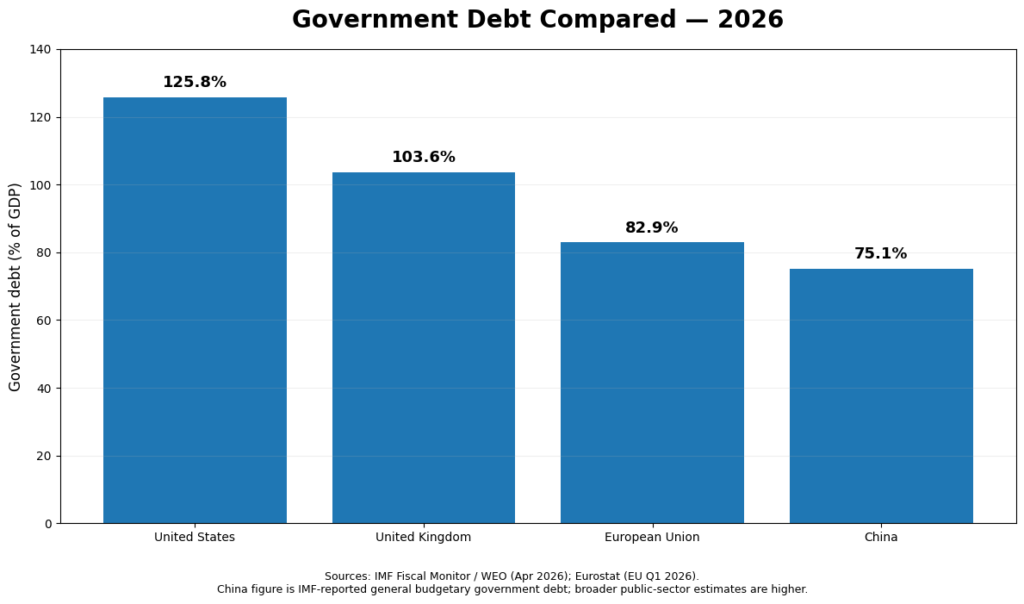
The purpose of this comparison isn’t to declare one country safe and another unsafe. It is to identify a global signal. High government debt combined with higher bond yields means governments have to allocate more money towards servicing existing and new debt. And money used for interest payments can’t simultaneously be spent somewhere else.
That’s where the Ripple Effect begins.
The First Ripple: Government Finances
Imagine a household with a large mortgage. If the interest rate rises substantially when that mortgage is refinanced, more household income goes towards servicing the loan. The household then has choices. It can earn more money, reduce other spending, use savings or continue borrowing.
Governments face a surprisingly similar problem. Higher bond yields can mean higher debt-servicing costs. That can reduce the money available for infrastructure, healthcare, education, benefits, defence or other government priorities.
Alternatively, governments can increase taxes or borrow more. But additional borrowing may create another problem. If investors are already concerned about the level of government debt, issuing still more debt may cause them to demand an even higher return.
Debt – Higher Yields – Higher Interest Costs – More Fiscal Pressure – Potential Additional Borrowing or Taxation
One action creates a reaction. And that reaction creates another.
The Second Ripple: Interest Rates and Inflation
Bond yields and central-bank interest rates aren’t the same thing.
The Bank of England sets its policy rate as part of its mandate to control inflation. Government bond yields are determined in financial markets and incorporate investors’ expectations about inflation, future interest rates, economic growth, government finances and risk.
But they are connected.
If investors believe inflation will remain high, they generally want greater compensation for lending money over long periods.
- Higher energy costs can therefore matter.
- Higher wages can matter.
- Government spending can matter.
- Economic growth can matter.
Even geopolitical events thousands of miles away can matter if they alter oil prices, supply chains, inflation expectations or government expenditure.
That is why reading one headline in isolation rarely tells us enough. We need to look at what it connects to.
The Third Ripple: Mortgages
Now the bond-market story starts getting much closer to home. Mortgage pricing isn’t determined solely by the Bank of England base rate.
Fixed mortgage rates are influenced by market expectations of where interest rates are heading, reflected through instruments including swap rates and government bond markets. If markets expect inflation and interest rates to remain higher for longer, borrowing costs can remain elevated even if households are hoping for Bank of England rate cuts.
This affects more than someone buying a new home.
- Existing homeowners eventually refinance.
- Landlords refinance investment properties.
- Property developers borrow to fund projects.
- Potential buyers calculate affordability.
- Banks assess lending risks.
If borrowing becomes too expensive, some buyers delay purchasing. Developers may reconsider projects. Investors may decide the numbers no longer work. That can eventually affect property prices, rents, construction activity and employment.
Suddenly our government bond story has become a property-market signal.
The Fourth Ripple: Business
Businesses borrow too. Higher financing costs can make expansion less attractive. A business considering a new factory, additional premises, machinery, vehicles or technology has to decide whether the expected return justifies the cost of the capital required. Some projects will continue. Others will be postponed.
At the same time, customers may be dealing with higher mortgages, rents, taxes and household expenses. That can reduce discretionary spending.
A business can therefore experience the effects of bond-market changes without ever owning a government bond. Its borrowing becomes more expensive while its customers become more cautious. That is why business owners need to understand what is happening outside their own industry.
The signal may appear a long way away. The Ripple Effect can bring it directly to their door.
The Fifth Ripple: Households
Eventually we arrive at the household and the effect on your purse strings.
- Higher government borrowing costs can contribute to pressure for higher taxes or constrained public spending.
- Higher market interest rates can affect mortgages and consumer borrowing.
- Higher business financing costs can affect investment and employment.
- Inflation affects the cost of everyday goods and services.
- Changes in property markets affect homeowners, renters, landlords and developers.
- Investment markets react as investors reassess the returns available from bonds compared with shares, property and other assets.
None of these things operates independently. That is the point.
Government Debt – Bond Yields – Interest Costs – Government Decisions – Interest Rates & Financial Markets – Mortgages & Business Finance – Spending & Investment – Households
The headline might say “Bond Yields Rise.” The household impact may not appear until several steps later.
This Is Why We Watch the Signals
Watching economic and financial news isn’t about trying to predict tomorrow’s stock market. It is about identifying changes that may influence the environment in which we run businesses and build wealth.
One bond-market story isn’t enough to make an investment decision. But suppose we are simultaneously seeing:
- government debt remaining high;
- bond yields rising;
- inflation pressures persisting;
- mortgage approvals weakening;
- property developments struggling to sell;
- consumers reducing discretionary spending;
- businesses becoming more cautious about investment.
Now we aren’t looking at one headline. We are looking at a cluster of signals. That is where interpretation becomes valuable.
Observation; Connection; Interpretation; Action
My approach to Business and Wealth Strategy begins with observation.
What is happening?
Then comes the step that is often missed.
What does this connect to?
If government borrowing costs rise, what reacts?
If mortgages remain expensive, what reacts?
If property transactions slow, what reacts?
If consumers spend less, what reacts?
And importantly:
Who benefits from solving the problems these changes create?
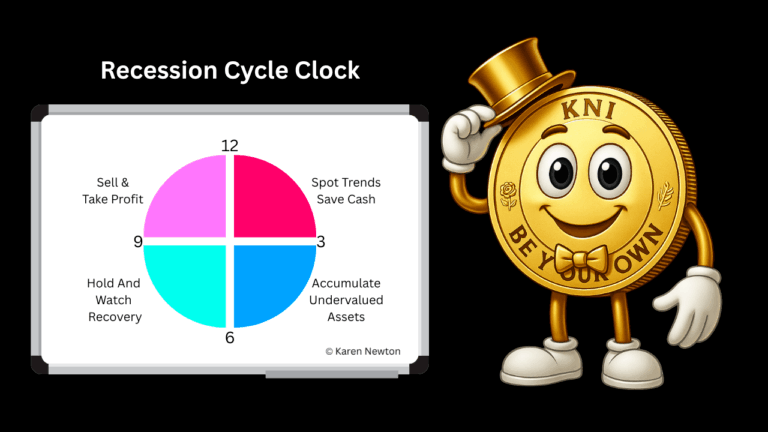
Once we understand the connections, we can start interpreting where we may be in the Investment Cycle. Only then do we consider action. That action could be buying. It could be selling. It could be holding.
It could mean increasing cash reserves, investing more into a business, reducing debt, diversifying or preparing for opportunities.
And sometimes the correct response within your own strategy will simply be do nothing.
The objective isn’t to react to every headline. It is to build a system that helps us recognise when several signals are beginning to tell the same story.
The Ripple Effect
Andrew Bailey’s comments about the pressures facing government bond markets aren’t a prediction of what happens next. They are another signal. High debt levels, structural government spending pressures, inflation uncertainty and elevated borrowing costs are interacting across many developed economies.
The important question isn’t: “What did Andrew Bailey say?” It is “If these pressures continue, what happens next?” Then, “What reacts to that?” And “How might that eventually affect my business, property, investments and household?”
That is how an apparently distant story about government bonds becomes relevant to everyday wealth decisions. Nothing happens in isolation. Follow the connections and you begin to see the Ripple Effect.
Further Reading

Podcast and Video Library
Frequently Asked Questions About Government Debt
Why do government bond yields matter to ordinary households?
Government bonds establish important reference points for borrowing costs throughout financial markets. Changes in yields can influence government finances, business borrowing, mortgage pricing and investment markets, with the effects eventually reaching household budgets.
Does a rise in bond yields mean interest rates must rise?
No. Government bond yields and central-bank policy rates are different. Bond yields reflect market expectations about factors including inflation, future interest rates, growth and fiscal risk. They influence each other, but one doesn’t mechanically determine the other.
Should investors change their portfolio because bond yields rise?
Not necessarily. One signal shouldn’t automatically trigger an investment decision. Consider it alongside other economic and market signals, your position in the Investment Cycle, your objectives and your personal attitude towards risk before deciding whether to buy, sell, hold — or do nothing.
Want to Follow the Ripple Effect Further?
Markets rarely move in isolation. A change in government debt, bond yields or interest rates can create consequences across property, businesses, investments and household finances.
The Strategic Investor Brief – The Ripple Effect takes a closer look at the signals developing across markets, explores the connections between them and considers what they could mean for investors.
It isn’t about predicting what happens next. It’s about observing the signals, understanding the connections and being better prepared for whatever comes next.
Subscribe to Strategic Investor Brief – The Ripple Effect
Karen Newton Ecosystem


Glossary
A definition of words and phrases used in this post Government Debt can be found in the Glossary

Karen Newton is a Business and Wealth Strategist, 3x #1 International Bestselling Author, Speaker and founder of Karen Newton International. She is known for helping entrepreneurs and investors connect business growth, investment opportunities, and economic trends into practical strategies for building long-term wealth and financial resilience.