
Financial Resilience For Young People
Financial resilience isn’t something we’re born with it’s something we learn. Every generation faces different economic challenges, and the skills needed to navigate them evolve over time. Growing up in South Wales during the 1970s, I saw first-hand how economic conditions shaped career choices and financial decisions…
I remember a period of high inflation, industrial unrest and rising unemployment. Leaving school in 1977, jobs were scarce, and finding secure employment was a priority for many young people.
That environment influenced my own career decisions. I chose to work in taxation because a job offer from HMIT a government departments was seen as a stable employer during uncertain economic times. Looking back, it wasn’t simply about finding a job; it was about managing risk. Economic conditions shaped the choices many of us made.
Today, I see similar patterns emerging, although the solutions are very different.
Key Points – Financial Resilience
- Economic conditions have always influenced career and financial decisions, from the high unemployment of the 1970s to today’s changing employment landscape.
- Many small businesses are finding it increasingly difficult to invest in apprentices, creating challenges for the next generation entering the workforce.
- Since the pandemic, more people have recognised the importance of building multiple income streams to reduce reliance on a single employer.
- Financial resilience is about creating options, not simply earning more money.
- Learning entrepreneurial skills at a young age can help build confidence, practical experience and financial independence.
- For many careers, developing income-generating skills before attending university may reduce financial pressure and provide valuable real-world experience.
- Specialist professions such as medicine, veterinary science and engineering will always require formal qualifications, but not every career follows the same path.
- Modern cottage industries and online businesses offer young people opportunities to earn, learn and develop valuable skills from an early age.
- Building financial resilience is one of the most effective ways to prepare for economic uncertainty and future career opportunities.
- The goal is not to avoid education but to create greater choice, flexibility and long-term financial security.
Table of Contents

Small Businesses Under Pressure
Recently, hairdressers have spoken publicly about struggling to afford apprentices. Rising employment costs and increasing business expenses mean many salon owners simply cannot justify taking on and training new staff.
This isn’t just a challenge for the hairdressing industry. Many small businesses face the same dilemma. They want to grow, they want to invest in the next generation, but financial pressures make expansion increasingly difficult.
The ripple effect extends beyond individual businesses. Fewer apprentices can lead to skills shortages, reduced opportunities for young people and increasing costs for consumers in the years ahead.
Economic pressures rarely affect only one group. They spread throughout the wider economy.
Why More People Are Building Side Hustles
One of the biggest changes since the pandemic has been the growth of side businesses.
For many people, the pandemic exposed the risk of relying on a single income. Businesses closed, jobs disappeared and household finances came under pressure almost overnight.
As a result, more people began exploring additional income streams as a way to build financial resilience using cottage industries style small businesses. Some sell handmade products. Some provide online services. Others create digital products, teach their skills or build content-based businesses.
What often starts as a side hustle gradually becomes something much more valuable—a second source of income, greater financial resilience and, in some cases, a completely new career.
The goal isn’t simply to earn more money.
The goal is to become less dependent on a single employer or income source.
Rethinking Education
This is one of the reasons I continue to support my Stop the Madness campaign.
For many professions, including medicine, veterinary science and other specialist careers, university remains essential. Society depends on highly trained professionals, and those qualifications are indispensable.
However, not every career requires immediate university education.
Too many young people feel pressured into taking on significant debt before they have had the opportunity to explore alternative paths or develop practical income-generating skills.
Imagine leaving school with the knowledge to build an online business, offer freelance services or create digital products that generate income.
Instead of relying entirely on student loans, that income could help fund further education while developing valuable business experience at the same time.
University then becomes a choice made from a stronger financial position rather than a decision driven by expectation alone.
There is nothing wrong with attending university later as a mature student. In fact, many people discover their real interests after gaining practical experience in the workplace or running their own business.
Adapting to a Changing Economy
Every generation adapts differently. In the 1970s, many sought secure employment. Today, increasing numbers are building multiple income streams, creating online businesses and developing skills that allow them greater flexibility.
Neither approach is right or wrong. Each reflects the economic realities of its time.
The important lesson is that economic conditions will always evolve. Rather than resisting change, we can prepare for it by developing adaptable skills, thinking independently and creating opportunities that provide greater resilience.
That is the philosophy behind Business and Wealth Strategy incorporating Cottage Industries.
Technology has made it possible for individuals to build businesses from home, reach customers around the world and generate income from knowledge, creativity and expertise. These businesses may begin as side hustles, but over time they can become significant assets that support both financial security and personal freedom.
Economic change is inevitable.
How we respond to it is a choice.
The more adaptable we become, the better positioned we are to navigate whatever comes next.
Further Reading


Podcast and Video Library
Frequently Asked Questions About Financial Resilience
What is financial resilience?
the ability to manage financial challenges, adapt to changing economic conditions and recover from unexpected events. It is built by developing valuable skills, creating multiple income streams, managing debt responsibly and making informed financial decisions.
Why is financial resilience important for young people?
Young people entering today’s workforce face a rapidly changing economy. Developing financial resilience early can provide greater flexibility, reduce financial stress and create more career opportunities throughout life.
What are multiple income streams?
Multiple income streams are different sources of earnings rather than relying on a single salary. They may include employment, freelance work, online businesses, digital products, investments or rental income, helping to reduce financial risk.
What is a modern cottage industry?
modern cottage industry is a small business that can often be operated from home using digital technology. Examples include online coaching, content creation, graphic design, consulting, e-commerce and selling digital products.
Should every young person go to university immediately after school?
Not necessarily. Some professions require university qualifications, such as medicine, veterinary science and engineering. However, many careers allow young people to gain practical experience, develop entrepreneurial skills and build financial resilience before deciding whether higher education is the right choice.
Can starting a side hustle help build financial resilience?
Yes. A side hustle can provide additional income, develop new skills and reduce dependence on a single employer. Many successful businesses begin as part-time ventures before growing into full-time opportunities.
Why are more people creating online businesses?
The pandemic highlighted the risks of relying on one source of income. Advances in technology have also made it easier to start online businesses with relatively low costs, allowing people to generate income from their knowledge, skills and experience.
How can parents help young people become financially resilient?
Parents can encourage financial literacy, teach budgeting, support entrepreneurial thinking and help young people explore ways to earn income while developing practical business and life skills.
Is financial resilience only about saving money?
No. Saving is important, but financial resilience also includes developing skills, increasing earning potential, managing risk, creating multiple income streams and making long-term financial decisions that provide greater security and choice.
What is the first step towards becoming financially resilient?
Start by investing in yourself. Learn valuable skills, understand how money works, explore opportunities to generate income and focus on building choices that will strengthen your financial future over time.
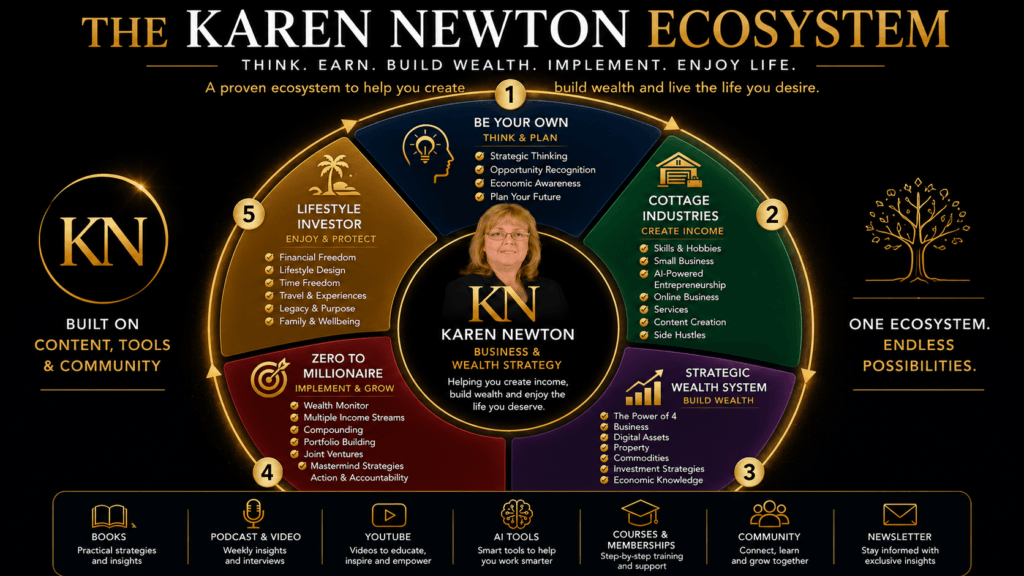
Karen Newton Ecosystem

Glossary
A definitions of words and phrases used in the post are available in the glossary

Karen Newton is a Business and Wealth Strategist, 3x #1 International Bestselling Author, Speaker and founder of Karen Newton International. She is known for helping entrepreneurs and investors connect business growth, investment opportunities, and economic trends into practical strategies for building long-term wealth and financial resilience.